CD-Rezensionen
CD bestellen | CD-Tracklist | CD-Hörbeispiele

Folker! Nr.1/2001 Januar-Februar
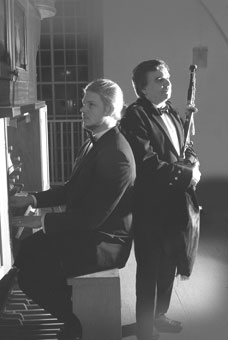
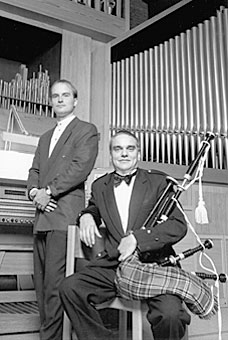
Herbert Bartmann ist einer (wenn nicht der) erfahrensten deutschen Bagpiper und hat mit dem Organisten Thomas Blum diese ungewöhnliche CD eingespielt. Klassik, Traditionals und Eigenes, wobei Orgel und Pipes auch jeweils einige Solo-Tracks haben. Doch in der Kombination der beiden Instrumente liegt der Reiz!
William Marshall in "Chanter" (The Bagpipe Society), Winter 2000/01
Highland bagpipes and church organ. An improbable combination, yes, but both are mighty instruments and there is no reason why they should not combine well. After all, the bombarde and organ duo has long been a feature of Breton music. German musicians Herbert Bartmann and Thomas Blum, have just released a CD, Duo Contrario, which establishes the potential of the Great Highland Bagpipe and organ combination. It is one of the most eclectic records you are ever likely to hear, with repertoire ranging from Italian baroque composers Gastoldi and Frescobaldi, through classic piobaireachd to a version of "Amazing Grace". And amazingly, it hangs together pretty well, not least because of the excellent musicianship. Herbert Bartmann is the piper. He began his musical life on the German folk scene, later studying piping in Scotland and is an expert player of the Highland pipes. He demonstrates this on Scottish material such as a set of jigs and the piobaireachd "MacKintosh's Lament". But he also uses the instrument unconventionally, accompanied by the organ on the Baroque pieces. For these he corks up the drones and this enables Bartmann to stop and start the chanter, demonstrating impressive control. The best track played in this way may be a suite of Bulgarian tunes arranged for pipes and organ by Bartmann. He also plays tin whistle and percussion on the CD. There is an attractive "Renaissance Suite" for whistle and organ and a set played on Scottish smallpipes. This disc would be an interesting addition to anybody's piping collection.
Jim Fraser in "Common Stock", Vol. 16 No 1, June 2001
This is an unusual album. The combination of pipes and organ initially requires a period to adjust the shell-likes to the sonorous, piercing, clinical, baroque bagpiping juxtaposed with the majestic, evocative, depth and tone of the church organ. Thankfully, and it does not take to long, Bartmann's and Blum's musicianship and technique either wins you over by track 3, or, if you still do not like it, will leave you astounded at their audacity in delivering such an innovative approach. While many of their contemporaries turn to the latest technology in their search for newer digital sounds Bartmann and Blum have plundered the past and reaped a rich harvest of analogue sound. From the opening track one to track twenty-five, Blum, the organist, is impressive. His atmospheric playing is on a continuum that ranges from moody to magnificently triumphant and serves to slightly soften the sharper, more piercing chanter sound. Bartmann has easily transferred his learning, skills and experience from the great pipe to the smallpipe. On track 18 he stamps his authority with an opening flourish of rippling bubbly notes. The rest of the track just gets better and better. This may not be a CD to suit everyone's immediate tastes. However you might want to consider spending some time allowing the CD time to grow on you and mature and you will be pleasantly rewarded. The inclusion of a web site is of tremendous help as it enables you to listen before you buy as well as listing their live gigs.
Eelco Schilder in "Folkworld" 12/2000
Herbert Bartmann and Thomas Blum are the musicians behind "Duo Contrario". Together they collected songs aged between the 300 and 600 years old from composers such as Gastoldi, Frescobaldi but also anonymous songs. Bartmann plays different kind of pipes, tin whistle and percussion while Blum plays the church organ. Most songs are a duet between pipes and organ although both instruments also have their solo parts. Because of the organ the music might sound religious to many people. This is not music everybody will like but music for the real fans. I think that Bartmann and Blum recorded a strong collection of songs in a passionate way. Together with the booklet it gives a view into a rich musical history. I think there will be persons who will appreciate this cd very much. Let 's speak for my self: I appreciated it very much.
Roland Ludwig in "Crossover" Nr. 16, 1/2001
So konträr, wie es der Ensemblename assoziiert, ist dieses Duo nun auch wieder nicht. Okay, Herbert Bartmann kann sein Instrumentarium problemlos mit sich herumtragen, während Thomas Blum akute Schwierigkeiten damit haben dürfte, aber ansonsten geben sich die beiden Hauptinstrumente des Duos, die Orgel und die Highland Bagpipe, volkstümlich auch als Dudelsack bekannt, förmlich die Klinke in die Hand und harmonieren so, als wären sie geradezu füreinander geschaffen worden, obwohl gerade in Schottland seit der Reformation bis ins 18. Jahrhundert hinein die Orgel für den Gottesdienstgebrauch mehr als verpönt war (Calvin und etliche andere Reformatoren waren ausgesprochene Orgelfeinde), so daß es im Jahre 1727 in gerade mal einer einzigen schottischen Kirche eine Orgel gab. Schon der Opener "In dir ist Freude" bringt eine perfekte Synthese aus Orgel und Highland Bagpipe zu Gehör, die lediglich aufgrund der von den üblichen EG- und EKG-Sätzen abweichenden harmonischen Gestaltungen etwas gewöhnungsbedürftig klingt. In der Folge wird das Programm sehr abwechslungsreich. Jedes Instrument bekommt Freiraum für Solostücke, so die Orgel mit einer Toccata von Girolamo Frescobaldi (auf den kein Geringerer als Johann Sebastian Bach große Stücke hielt), die Highland Bagpipe mit James Malcolmesons "Mackintosh's Lament", einem Piobaireachd (schottische Sackpfeifen-Kunstmusikgattung) und die nahe verwandte Scottish Smallpipe mit einer wettbewerbsartigen Komposition von Peter MacLeod und Willie Ross ("competition type tunes" wurden speziell für die Wiedergabe bei Sackpfeifen-Wettbewerben geschrieben). Außerdem runden diverse weitere Instrumente des altbritischen Kulturkreises einige andere Stücke ab. So veredelt die irische Tin Whistle (Blechflöte) eine "Renaissance Suite" von Michael Praetorius und evoziert dabei erstaunliche Parallelen zu Ian Andersons Querflötenparts bei Jethro Tull, und schließlich taucht auch noch der/die/das Bodhran auf, eine irische Handtrommel mit einem vollen, fast paukenartigen Klang (wer Lust hat, versucht mal herauszufinden, welche der Percussions tatsächlich von diesem Instrument stammen und welche die Orgel imitiert hat). Zwar mag manch einem das komplette Programm der CD etwas zu vielschichtig vorkommen, aber man mag sich angesichts der aus Herbert Bartmanns Feder stammenden "Bulgarian Suite" mit ihren "schiefen" Taktarten (9/16 und solche Späße) vor Augen führen, daß es sackpfeifenartige Instrumente nicht nur auf den britischen Inseln gab und gibt und daß man sich deshalb nicht wundern sollte, gälische Melodik neben italienischer Renaissance oder eben bulgarischen Volksliedthemen vorzufinden. Für meinen Geschmack hätt's anstelle des einen oder anderen Solostücks lieber noch ein paar mehr der exquisiten Kombinationen Orgel-Highland Bagpipe geben können, aber gegen Ende bekommt dieser Zug in mir angesichts mehrerwähnter "Bulgarian Suite", besonders wegen deren prächtig ausharmonisierten 4. Satzes, viel Futter. Und das Beste hat man sich bis zum Schluß aufgehoben: "Amazing Grace" läßt es mir in puncto Harmonik abwechsend heiß und eiskalt den Rücken runterlaufen, als wäre dieses Stück genau für diese Be- und Umsetzung geschrieben worden. Sorry, aber da kommt kein Gospelchor und keine Rockversion mit. Als Hidden Track wird uns noch eine Liveversion von "Der Mond ist aufgegangen" serviert (den Satz kenn' ich irgendwoher, aber es ist weder der von Hermann Stern noch der von Max Reger, obwohl die erste Zeile mit letztgenanntem übereinstimmt), nicht ganz so zwingend wie "Amazing Grace", aber ebenfalls von superber Qualität. Damit endet eine einstündige Reise in für die meisten Ohren völlig ungewohnte, aber faszinierende Klangdimensionen, die sich jeder, dessen musikalischer Horizont über Billigdancefloor, Stumpfmetal und flache volkstümliche Musik hinausgeht, auf seinem "Unbedingt anchecken!"-Zettel vermerken sollte. Gleichzeitig darf dieses Review als Aufruf an alle Pfarrer verstanden werden, sich dieses Duo in ihre Gotteshäuser zu holen, um der Gemeinde ein außergewöhnliches musikalisches Erlebnis zu bieten. (...) Das sehr informative, dreisprachige Booklet sei abschließend auch noch lobend erwähnt.
CD bestellen | CD-Tracklist | CD-Hörbeispiele